
Facing Fears
It’s a subject that I don’t think gets enough credit in dog training discussions.
Nowadays, “Fear Free” is a trendy description that gets thrown around by trainers who choose to lean on emotional language to market their services rather than documented results.
But it makes sense why – Who would want to openly admit that they intentionally use fear as a motivation for achieving results in training?
While “Fear Free” seems noble at first glance, on a closer look, pure avoidance of fearful stimuli reveals itself to be impractical at best and downright harmful at worst.
Dogs are alien to this world. None of this makes very much sense to them: Why the fire alarm beeps, why the garbage cans are on the street this morning, why the night sky erupts every evening from mid-June to late-August.
Dogs can never understand these things. Since we can, it’s easy for us to write the fearful dog off as broken, irrational, or difficult, and see his fear as something like an illness to be managed or medicated away instead of an intricate survival mechanism designed to provide for his comfort and safety.
This is why you’ll never catch me spouting “Fear Free” nonsense. To me, fear in the dog is something to be honored and celebrated for what it is: the specific motivational state that enables my dog to KEEP BEING HERE WITH ME. Despite all the things in the world out there trying to take him (and me) out.
While I appreciate that my dogs want to protect their bodily integrity from the strange, loud flashes in the sky, there are times when such fears are obnoxious to deal with and stressful for the dogs, especially when they can’t dig a hole in my house deep enough to get away from the noise. I get that, and I feel for them.
Every 4th of July my social feeds are filled with a litany of (mostly) passive-aggressive posts from dog people about the horrors of firework-lighting. I’ve never been one for the collective scolding. I have a calendar, and a functioning memory. We all know when the big fireworks nights are. There’s like 3 or 4 out of a whole 365 day year. Yeah sometimes people light fireworks other nights as well. Anyway, have you ever met a fireworks enthusiast who responded to the nagging by deciding not to light theirs off? I haven’t. What are you going to do about it?
My dogs are afraid of the fireworks. What I do is take my dogs inside the house those evenings. I also train my dogs well enough so that if they get spooked I can get them back under control. That’s just me.
But that’s not really the point of this post.
I used to tell my students, “The antidote to fear is knowledge.” There are some who swear by firework habituation methods. I suppose the idea there is that when the dog learns the sound of an explosion doesn’t accompany something that might hurt him, he’ll stop being afraid of it.
I’m not really sure that’s what I’d call an antidote. More like an inoculation.
A true antidote acts against the poison.
As I’ve come to understand it, the antidote to fear isn’t knowledge, it’s agency. When a dog (or person for that matter) acts in such a way that he escapes or avoids an encounter with the object of his fear, he feels a sense of relief, joy even, as the tension of his prior fear-motivated state relaxes and he returns to homeostasis.
With the fireworks, there is no agency. Nothing the dog does can cause him to escape, avoid, or even predict the explosion. I’m sure the habituation methods work, I’ve just personally never bothered with them.
Instead, Hannah and I decided to just skip town with the dogs and head up to the Uinta range where we weren’t likely to encounter any firework-enthusiasts. Maybe you could call that choice “Fear Free,” in a contorted sense.
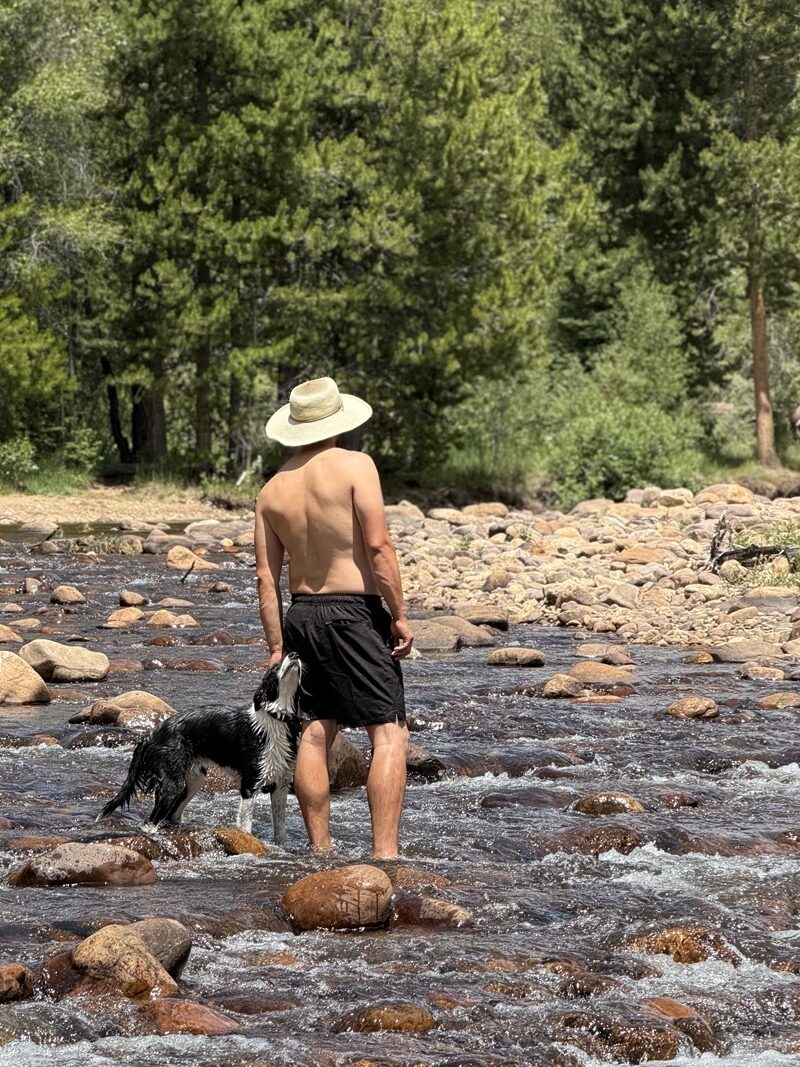
But on the topic of facing fears, one of my dogs, Monkey, has never really been around deep or running water before. I knew that like most dogs, he’d have an instinctive fear of swimming in rushing water. I do a lot of hiking, backpacking, hunting. Sometimes we have to cross running water. If Monkey’s going to keep being here with me, he’s going to have to learn to cross running water.
While we were up there I found the perfect spot on a fork of the Provo for Monkey’s first water crossing.
Could I have gone the “Fear Free” route of slowly habituating him to little drips and drops of water, eventually building up to crossing a small stream then a stagnant pond, and eventually a couple years down the line, ask him to cross a flowing river?
No. I don’t have the time or patience for that.
Neither does Monkey. Dogs don’t live forever. They don’t even live anything close to a human lifespan. I can’t, in good conscience, waste what precious little time a dog does have on this planet with clownish moral posturing about how “Fear Free” I’m being.
I walked Monkey down along the side of the river to a place where he’d have no option but to swim in order to get across. Then I said, “Good luck bud,” waded across the river myself, and made like I was going to continue on away from the opposite bank either with or without him. His call.
Do I have any illusions about whether Monkey was afraid of swimming across? No. Am I kidding myself that he wasn’t worried that I would leave him behind? Absolutely not. That was the point.
Can you guess what happened next?
The dog jumped in the water and swam across. No forcing, no coaxing. Just the fear of being left behind counteracted by the relief he felt by restoring our bond.
This is what I mean by Facing Fears, and why I am a major advocate of using fear in training.
Monkey will remember this next time I ask him to do something fearful. He’ll remember how it was hard at first but it felt good in the end, and he’ll learn to trust that I’ll never ask him for something I know he isn’t capable of giving.
There will be other rivers – wider, deeper, faster currents. He’ll cross them.
I won’t force him. I won’t have to. He’ll keep being here with me.